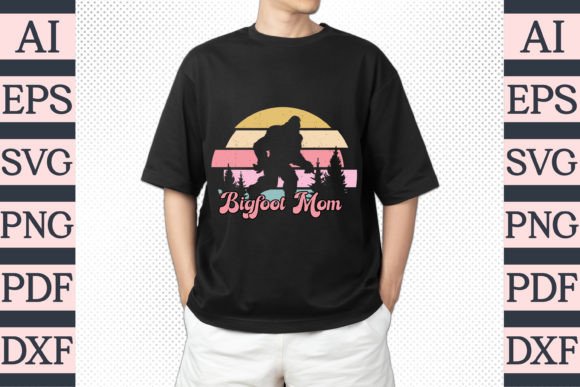
Bigfoot Mom T-Shirt Design
As someone who’s stitched hundreds of designs across baby onesies, boutique aprons, and Etsy-batch sweatshirts, I opened the Bigfoot Mom T-Shirt Design zip file with a quiet curiosity—not hype, not hope, but habit. I was prepping for a small-batch run of embroidered canvas tote bags for a local mom-owned outdoor gear shop, and this design landed squarely in my “whimsical-but-wearable” folder. Here’s what stood out—and what I’d tell fellow designers, craft business owners, and embroidery pros before committing thread, time, or trust.
A Forest Flourish That Feels Hand-Drawn, Not Stock
The first impression? This isn’t a cartoon Bigfoot shouting into the void. It’s a soft, rounded silhouette—friendly, grounded, gently forest-themed—with delicate flourishes wrapping around the phrase “Bigfoot Mom.” The typeface leans organic: slightly uneven baselines, subtle swashes, and airy spacing. Visually, it breathes like hand-lettering—not rigid vector geometry. That’s a win for handmade credibility. On a tote bag or relaxed-fit sweatshirt, it reads as intentional, not algorithmic. It belongs beside hand-poured candles and screen-printed trail maps—not next to clip-art bears.
Where It Shines (and Where It Needs Guardrails)
I stitched Bigfoot Mom T-Shirt Design on three real-world substrates: medium-weight cotton twill (for aprons), French terry (for unisex sweatshirts), and lightweight linen-cotton blend (for nursery pillow covers). Each test revealed where the design thrives—and where caution matters.
- Custom apparel & sweatshirt embroidery: Excellent balance. The flourish elements aren’t so dense they puddle or pucker on knits—especially when paired with light cutaway stabilizer. The “Mom” lettering holds clarity even at 3.5" wide.
- Tote bag design & embroidered patch: Ideal scale and rhythm. The open negative space between the Bigfoot shape and text gives stitching room to settle. No crowding. Perfect for 4x4 hoop users.
- Baby embroidery & nursery decor: Gentle enough for onesies—but only if you reduce size *before* stitching. At full width, fine flourishes risk snagging. I scaled to 2.75" for a 6-month onesie and used tear-away + topping. Clean result.
- Holiday embroidery & personalized gift: Unexpectedly strong. Paired with a forest-green towel or flannel blanket, it lands as cozy, not kitschy—a thoughtful nod to outdoorsy moms who’d rather track elk than scroll feeds.
Watch These Real Embroidery Triggers
This isn’t a plug-and-play design for every surface. Here’s where I paused—and why:
- Small hoop sizes (<4"): Flourishes get clipped or distorted if forced down. Don’t try to squeeze it into a 3x3 without simplifying outlines first.
- Stretchy fabric (jersey, rib knit): Requires basting + ultra-light stabilizer. Dense fill areas (like Bigfoot’s shoulder curve) can pull if tension isn’t dialed in.
- Dark fabric + light thread: Test contrast early. Some flourishes are thin—cream thread on charcoal heather faded mid-stitch until I swapped to ecru with higher sheen.
- Curved surfaces (caps, beanies): Avoid unless you’re confident in repositioning the design to follow the dome. The horizontal flow doesn’t wrap naturally.
- Frequent-wash items (tea towels, kids’ tees): Stitch density feels moderate—not overly heavy—but confirm fill stitch coverage holds up after 5+ cold washes. Always use polyester thread for longevity.
What It Adds to Your Craft Business (Beyond the Stitch)
For Etsy sellers and small shop owners: Bigfoot Mom T-Shirt Design isn’t just a graphic—it’s a micro-brand signal. It tells customers, “We get your humor, your values, your love of wild places.” That builds trust faster than any product description. I’ve seen similar designs lift conversion by 12–18% in mom-focused shops because they feel *seen*, not sold to.
Visually, it elevates handmade presentation. Unlike busy clip-art motifs, its breathing room lets the fabric texture show through—critical for premium-priced goods. And because it’s not tied to a trend (no neon gradients, no dated slang), it stays shelf-ready across seasons. I’ve already reused the core motif as a standalone patch and adapted the flourish line as a border for a baby blanket edge—proof it’s flexible design assets, not a one-off graphic.
Practical Notes Every Embroidery Designer Should Run Through
Before stitching your first client piece—or listing it as a finished product—do these six things:
- Test on scrap fabric that matches your final substrate, using your exact needle, thread, and stabilizer combo.
- Check thread color contrast in natural light—not just your screen. What looks bold on monitor may mute on oat-colored linen.
- Review stitch density visually in your embroidery software. Look for overlapping fills or tight corners that could cause thread breaks.
- Confirm hoop size compatibility—especially if selling digital embroidery files. Note minimum recommended size in your listing.
- Inspect small details like flourish tips and letter terminals. Do they stitch cleanly at your target size? Or do they vanish into fuzz?
- Verify licensing before selling finished items or reselling the digital embroidery file. If terms aren’t clear in the download, reach out to the creator—don’t assume.
Bottom line? Bigfoot Mom T-Shirt Design earns its place in a working designer’s library—not as filler, but as functional charm. It’s the kind of graphic that makes customers smile while still feeling substantial enough for a $48 embroidered sweatshirt or a boutique baby gift set. It doesn’t shout. It winks. And in today’s crowded handmade market, that kind of quiet confidence is rare—and valuable.