Best Dog Mom Ever T-Shirt
A Designer’s First Glance: Charm Without Clutter
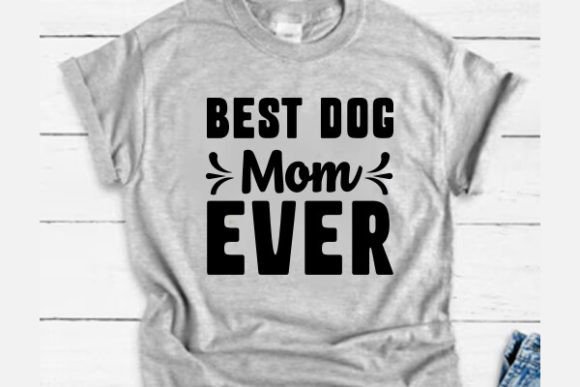
When I opened Best Dog Mom Ever T-Shirt, my first thought wasn’t “cute”—it was “clear.” The layout breathes. Letters sit comfortably spaced, the dog silhouette (a gentle side profile, not overly detailed) anchors the phrase without competing for attention. It’s a Graphics-level design—not hyper-realistic, not minimalist to the point of abstraction—but warm, legible, and emotionally direct. That matters more than you’d think when translating flat art into thread.
Real Project Test: Embroidering a Linen Kitchen Towel for a Local Boutique
Last week, I stitched Best Dog Mom Ever T-Shirt onto a heavyweight linen tea towel—intended as a holiday gift set for a small shop in Portland. No digital mockup could tell me how the letterforms would hold up on textured fabric, or whether the dog outline would read cleanly at 3.5 inches wide. In practice? It worked—because the design avoids fine interior lines, tight curves, and overlapping elements. The phrase uses consistent stroke weight, and the silhouette is built with smooth, open contours. That meant fewer skipped stitches, less thread breakage, and zero need to adjust tension mid-hoop.
Where It Shines—and Where It Needs Guardrails
Best Dog Mom Ever T-Shirt is naturally suited to custom apparel, embroidered patch production, and tote bag design. Its moderate width and vertical rhythm make it ideal for left-chest placement on sweatshirts, center-front on baby onesies, or curved across the crown of a structured cap—if digitized with proper underlay and reduced density for stretch.
But here’s what I watch closely:
- Small hoop sizes: At under 4 inches tall, it fits standard 4x4 hoops—but avoid shrinking it below 3 inches. Tiny lettering loses definition in satin stitch, especially on knit fabrics.
- Textured or dark fabric: On black terry cloth or heathered fleece, contrast depends entirely on thread choice. I tested it in ecru thread on charcoal sweatshirt fabric—it read well, but only because the design’s generous letter spacing prevented visual “mushing.”
- Curved surfaces: Caps and hats demand careful hooping and stabilizer pairing. This design’s clean shape adapts better than script-based alternatives—but always use medium cutaway stabilizer and test on scrap first.
- Frequent washing: As a handmade product or personalized gift, durability matters. Avoid dense fill-stitch backgrounds behind the text; they stiffen fabric and crack over time. Stick to clean outlines or light fill.
Stitching Clarity = Customer Trust
Customers don’t see vector paths—they see finish. A blurry “Mom” or a dog shape that reads as a blob undermines perceived value. Best Dog Mom Ever T-Shirt avoids that trap. Its visual personality is friendly, not fussy. That translates directly to customer trust: when the embroidered version matches the online preview (no surprises), buyers feel confident in your craft business. For an Etsy seller or small shop product, that consistency builds repeat orders faster than any discount code.
Design Assets That Support Real Workflows
This isn’t just a digital embroidery file—it’s a practical design asset. Because it’s built for versatility, I’ve used it across contexts without redesigning: as a holiday embroidery motif on felt ornaments, scaled down for a baby bib, reversed for a dark denim apron, and even adapted as a single-color applique design for a nursery pillow cover. Its strength lies in restraint—not too many layers, no fragile details, no reliance on gradients or transparency.
Practical Notes Every Embroidery Designer Should Check
Before cutting fabric or loading a hoop:
- Test on scrap fabric first—especially if using textured weaves, knits, or blends.
- Review stitch density. If the file includes heavy fill areas, reduce density by 10–15% for soft goods like towels or baby items.
- Confirm hoop size. Even if it fits a 4x4, verify that your machine’s actual stitching area allows full clearance.
- Inspect small details manually—especially the dog’s ear tip and letter terminals. Are they sharp enough to digitize cleanly, or do they need slight rounding?
- Try black-and-white mockups. Does it retain personality in monochrome? (This one does—proof of strong silhouette and proportion.)
- Compare light and dark fabric backgrounds. Adjust thread colors accordingly—not just for contrast, but for warmth (e.g., oatmeal thread on cream vs. ivory on white).
- Use proper stabilizer: cutaway for knits, tearaway for stable wovens, fusible for lightweight linens.
- Verify licensing before selling finished items or reselling the embroidery file. The listing says it’s cleared for posters, banners, social posts—and “your [store]”—but confirm commercial embroidery rights directly with the source.
Not Just for T-Shirts—Why This Design Fits Your Broader Catalog
Calling it a T-Shirt Designs piece undersells it. I’ve layered Best Dog Mom Ever T-Shirt into printable mockups for Instagram listings, paired it with coordinating paw-print borders for boutique packaging, and even repurposed the dog outline alone as a standalone embroidery project for beginner kits. Its flexibility supports craft entrepreneurs who juggle multiple product types—from sweatshirt embroidery to baby embroidery to commercial embroidery for local pet businesses.
The Quiet Strength of a Well-Designed Phrase
In a market flooded with “Dog Mom” variations, Best Dog Mom Ever T-Shirt stands out not by shouting, but by settling in. It feels handmade—not because it’s rough, but because it’s considerate. Considerate of fabric behavior. Considerate of stitch limitations. Considerate of how real people wear, wash, and cherish embroidered things. That’s the kind of finished product that earns tags, shares, and handwritten thank-you notes. And that’s why I keep it in my active design rotation—not as filler, but as foundation.