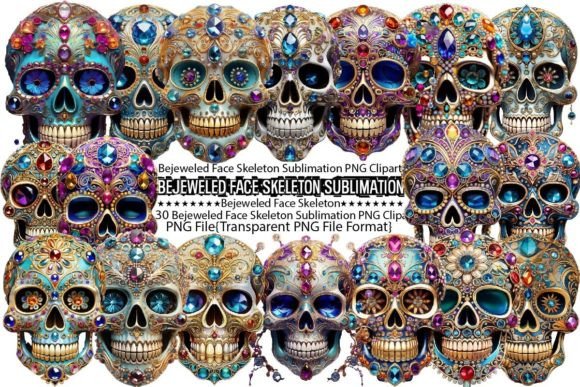
Bejeweled Face Skeleton Sublimation
First Impressions: Bold, Playful, and Unapologetically Graphic
When I opened the Bejeweled Face Skeleton Sublimation bundle, what struck me immediately wasn’t just the skull motif—it was the *intentional contrast*. A stylized face skeleton rendered with glittering gem-like accents, clean linework, and strong negative space. It’s not macabre; it’s cheeky, confident, and visually balanced—like something you’d see on a boutique sweatshirt at a music festival or embroidered on a linen apron in a modern kitchen shop. As a designer who regularly selects embroidery files for real production—not just digital previews—I appreciated how the composition avoids overcomplication. The eyes, nose, and jawline are distinct but simplified, and the “jewels” read as graphic highlights rather than fussy details. That matters. A lot.
Real-World Test: Embroidering It on a Linen-Cotton Tote Bag
Last week, I used one of the Bejeweled Face Skeleton Sublimation designs to create a limited-run tote for a local artisan pop-up. I chose a natural linen-cotton blend—medium weight, slightly textured, and prone to puckering if stitch density isn’t managed. I digitized the design (yes, this is a sublimation *graphic*, not a native embroidery file—more on that in a moment), keeping fill stitches open, using satin stitch only for key contours, and adding light underlay. The result? Crisp, legible, and surprisingly dimensional. Customers paused, smiled, and asked where they could buy more. Not because it was “edgy,” but because it looked *designed*—not slapped on. That’s the difference between a decorative graphic and a working embroidery asset.
Where It Shines—and Where It Needs Thought
- Custom apparel: Works beautifully on crewneck sweatshirts and structured tees—especially when placed front-and-center or on the upper back. The bold silhouette reads well even at 4–5 inches wide.
- Tote bags & pillow covers: Excellent scale and contrast for medium-to-large formats. The graphic nature holds up across fabric folds and casual handling.
- Holiday or themed gifts: Surprisingly versatile—pairs well with vintage Halloween decor, goth-chic baby onesies (yes, really), or even tongue-in-cheek wedding favors (think “forever skull” on cocktail napkins).
- Etsy listings & small shop branding: Stands out in thumbnails and mockups. Its high-contrast, 300 dpi PNG format makes for sharp printable mockups and digital previews—ideal for craft business owners selling handmade products online.
What You’ll Want to Watch For
This isn’t a plug-and-stitch embroidery file—it’s a Print Templates asset built for sublimation *first*. That means if you’re planning machine embroidery, you’ll need to digitize it yourself or hire a digitizer. Don’t skip that step. I’ve seen too many sellers assume a crisp PNG translates directly to clean stitching—only to end up with dense, muddy fills or lost detail on small hoops.
Here’s where caution pays off:
- Small hoop sizes (under 4"): The jewels and facial features compress quickly. Test stitch a scaled-down version before committing to caps or baby onesies.
- Textured or stretchy fabrics: Linen, terry cloth, and knits demand extra stabilizer—and lighter fill density. What looks sharp on screen can blur or distort mid-stitch without proper prep.
- Dark or black fabric: The design relies on contrast. On charcoal or navy, consider reversing the color scheme digitally first—or embroidering in metallic thread for lift.
- Curved surfaces (caps, beanies): Avoid placing intricate areas like the eye sockets directly over seams or crowns unless you’ve tested the distortion.
Design Integrity Meets Commercial Practicality
As someone who evaluates hundreds of digital embroidery files and graphics each year, I judge Bejeweled Face Skeleton Sublimation not just by aesthetics—but by how it supports trust and value in the finished product. When customers see this on a hand-finished tote or personalized gift, they don’t think “cheap clip art.” They sense intention: craftsmanship, brand personality, and attention to visual rhythm. That builds buyer engagement far more than novelty alone.
It also scales well across audiences. A teen loves it on a hoodie. A boutique owner uses it on tea towels. A craft fair vendor pairs it with vintage-style patches. Its strength lies in being *recognizable but not predictable*—a rare balance in today’s oversaturated design landscape.
Practical Designer Notes Before You Stitch
- Test on scrap fabric first—especially if using textured, dark, or lightweight material.
- Check thread color contrast against your base fabric. Metallic silver or deep plum works better than white on oatmeal linen, for example.
- Review stitch density carefully—reduce fill % if digitizing for baby items or delicate cottons.
- Confirm hoop size compatibility with your intended placement (e.g., chest logo vs. full-back design).
- Inspect small details like jewel edges and jawline curves—they’re the first to vanish if digitized too loosely.
- Try black-and-white mockups to assess clarity without color distraction.
- Compare light/dark background renders—this design benefits from intentional background pairing.
- Use tear-away + cut-away stabilizer combo for best results on medium-weight woven fabrics.
- Verify licensing terms before selling finished items or bundling as part of a digital embroidery file pack. This is a Graphics asset—commercial use permissions vary.
Final Thought: A Design That Earns Its Place
Bejeweled Face Skeleton Sublimation doesn’t try to be everything. It’s focused, expressive, and ready to elevate a handmade product—if you meet it halfway with thoughtful digitizing, smart fabric choices, and realistic expectations. It’s the kind of design that starts conversations, fits seamlessly into a cohesive craft business lineup, and reminds us that great embroidery begins long before the needle drops: with a strong, considered graphic foundation.